What we have worked out about sun, wind and glass on a house facing open Highveld grassland: which elevation suffers when, what we'd put on each, and what only a tape measure can settle.
Roughly a ten-minute readSources listed at the footNothing gated, nothing to fill in
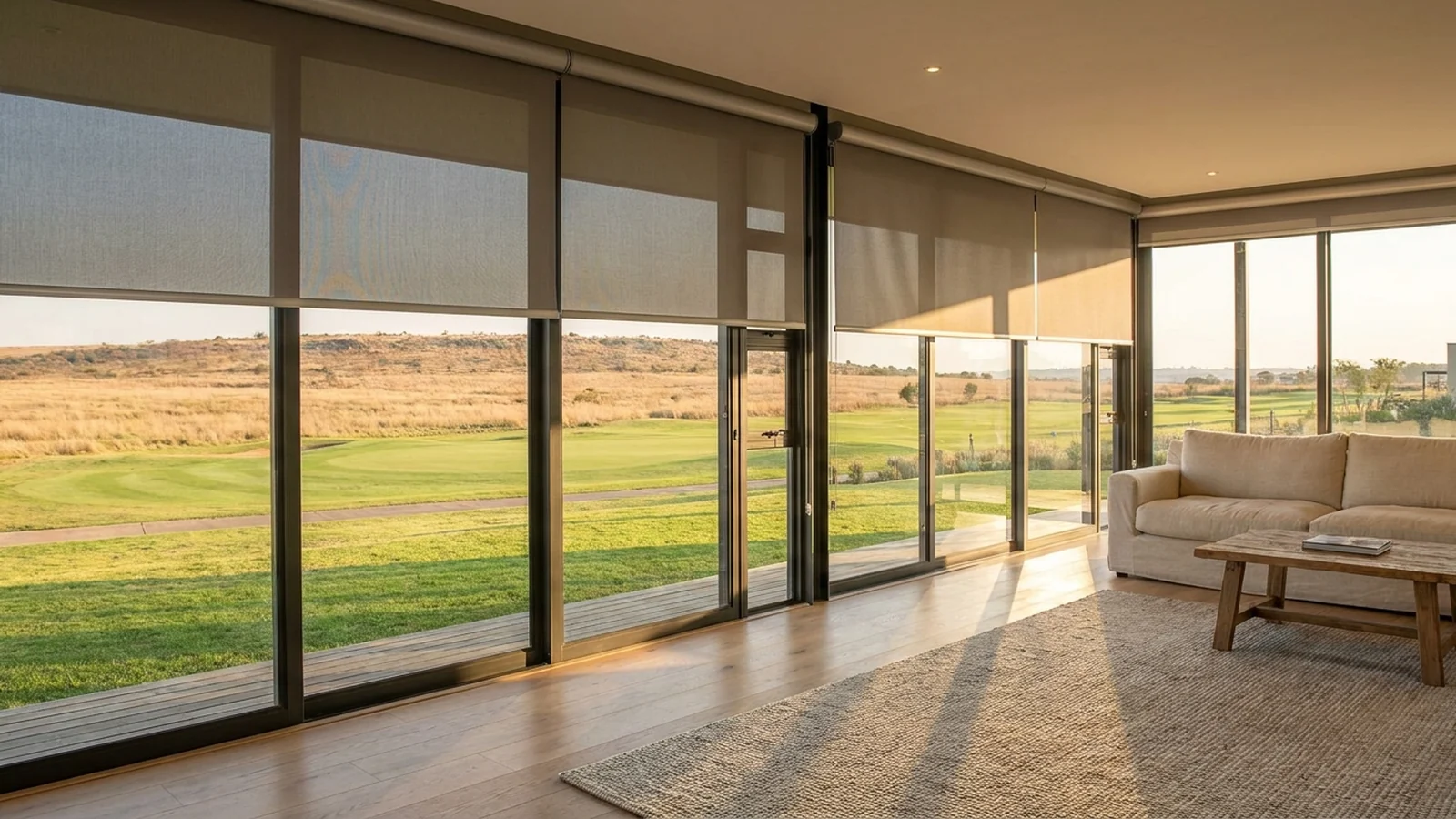
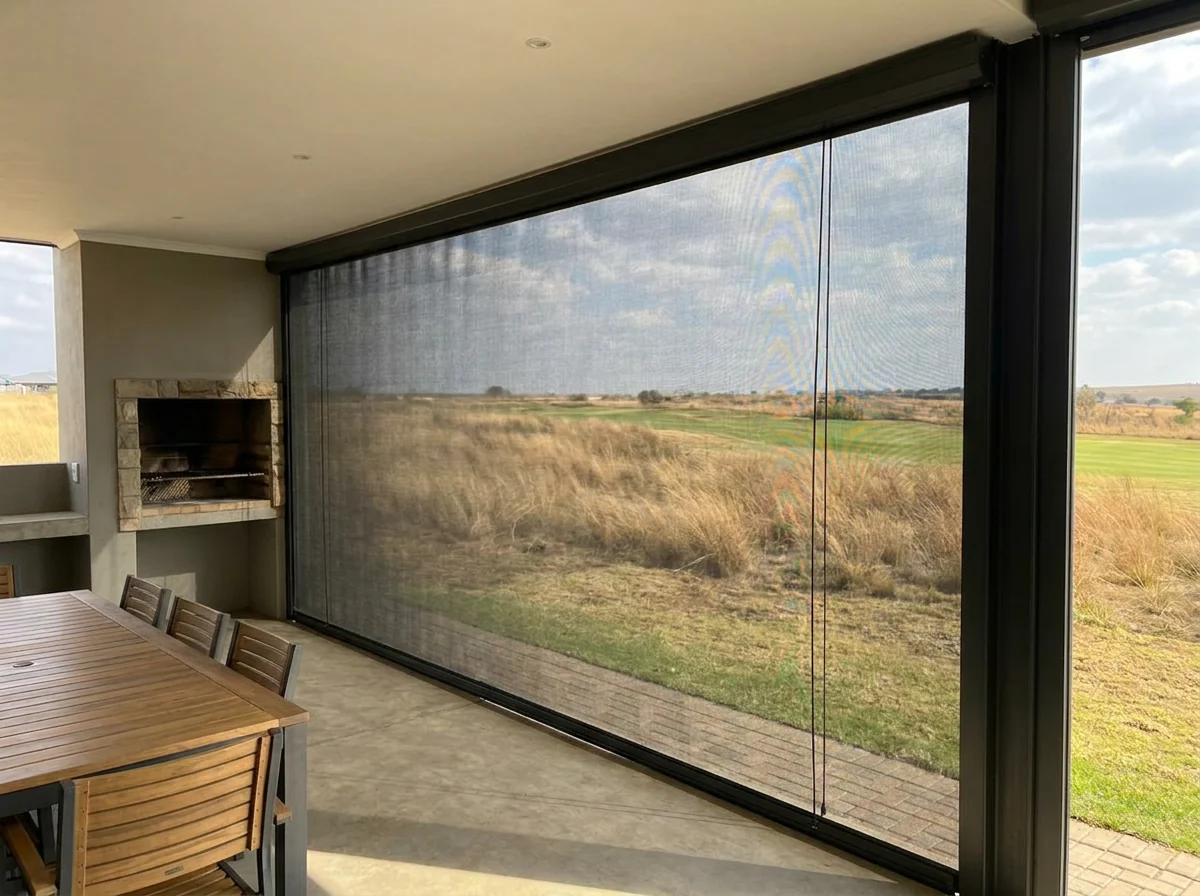
Half-drawn sunscreen on a fairway-facing wall: the glare goes, the reason you bought the stand stays.
Where you actually live
Built to face the view — which is not the same as built to face the sun.
Eye of Africa runs to roughly 700 hectares in Midvaal, about 17 kilometres south of the Johannesburg CBD, and around 350 of them were left as undeveloped Highveld grassland. That is the appeal, and it is also the shading problem: no street canopy, no neighbour's wall. Glass, grass and sky.
The estate's own architectural guidelines say the quiet part out loud. Siting a house here means weighing view against orientation — and "the need for a special view can in some cases override the desire for a north orientation." Elsewhere the same document instructs that "the number of windows to the West is to be minimised or appropriate screening devices installed."
Together they are the brief for this handbook: much of the best glass here points at what looks best rather than what behaves best.
The light
Twenty-six degrees south, and a sun that swings fifty-two degrees between solstices.
The estate sits at about 26.4° south, on a plateau running between 1,400 and 2,100 metres above sea level. Both numbers matter, in opposite seasons.
Midsummer: nearly overhead, rising and setting behind you
At the December solstice the sun rises at 05:12 on a bearing of 116° and sets at 18:59 on 243° — 26° south of due east, 27° south of due west. At noon it is roughly 87° up. The middle of a summer day is therefore easy; the ends of it are not, and glass you were told never gets sun catches it.
Midwinter: low, northern and welcome
At the June solstice sunrise swings back to 64° and sunset to 295°, and midday only reaches about 40°. Daylight drops from 13 hours 49 minutes to 10 hours 28. That low northern sun drives deep into north-facing rooms — and with July lows near 1 °C, you want it there.
Clear skies make it relentless rather than soft
July is the clearest month — clear, mostly clear or partly cloudy 91% of the time — November the cloudiest at 36%. Add altitude, where ultraviolet rises roughly 10% per thousand metres, and you get what owners notice second: floors and rugs losing colour on the sunny side first.
Storms and wind decide what survives outside
The Highveld runs a thunderstorm season from October to March, and over Gauteng supercell frequency peaks in October and November, carrying large damaging hail and strong winds. September is the windiest month, averaging around 16 km/h, with nothing upwind to slow it.
Room by room
Four faces of the house, four different arguments
Which face your worst room sits on changes the answer completely.
North
The one to protect, not to block
Winter sun arrives all day at a low angle, and the guidelines ask that living areas get at least three hours of it. Summer sun on the same wall is almost overhead, so an overhang or a retractable awning removes it without costing you the winter gain.
What we'd fit: something adjustable or retractable, never a fixed screen.
West
The problem elevation, every time
Late-afternoon sun comes in almost horizontally, under any eave, in the hottest hours. By four o'clock a west-facing lounge is often the room nobody sits in — the face the guidelines single out for screening.
What we'd fit: stop it outside the glass — that is a difference in kind, not degree.
East
An early-morning problem, not a heat one
Midsummer first light lands at 05:12, and because sunrise sits south of due east it reaches further round the house than people expect. Bedrooms here are a darkness question, not a temperature one.
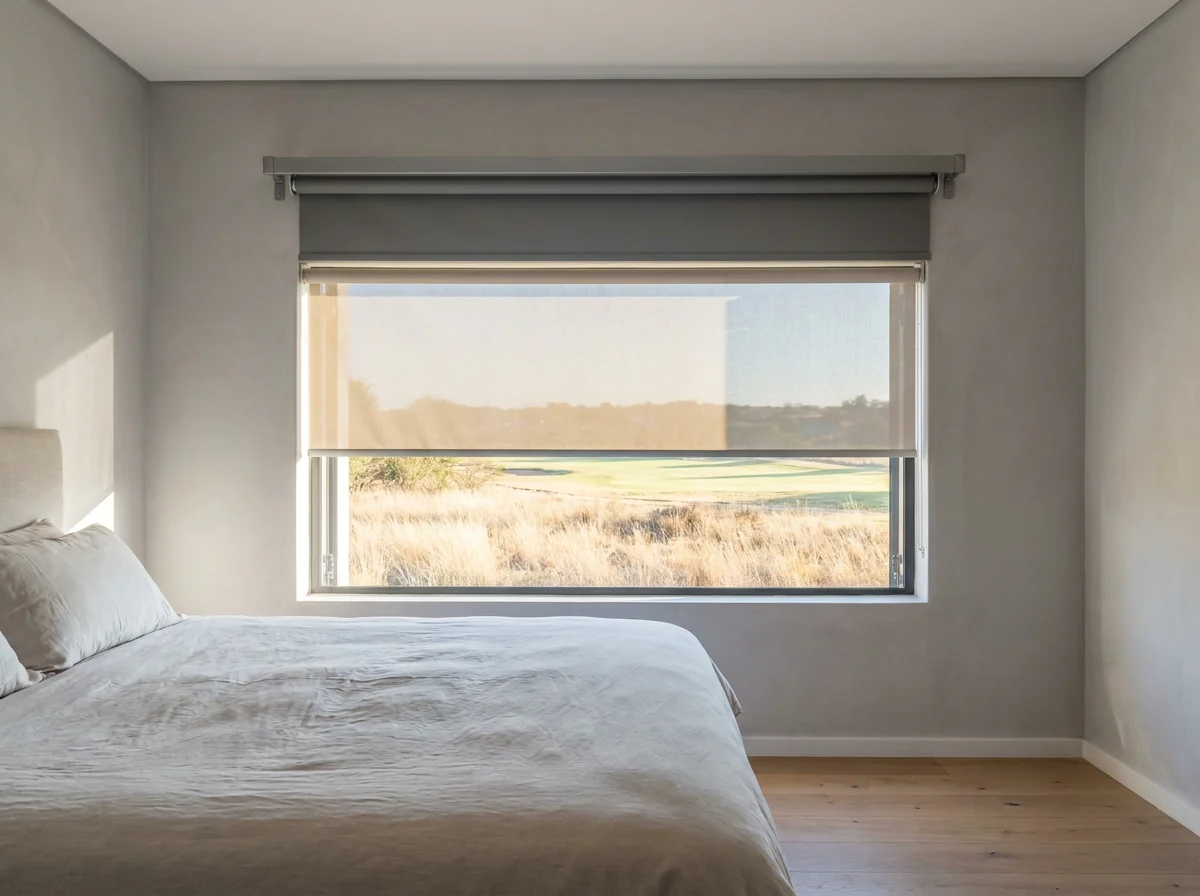
What we'd fit: a blockout layer, plus something you can leave down by day.
South
Glare without heat — and the fairway is a mirror
South glass takes little direct sun but a great deal of bounced light: bright turf and dry winter grass throw glare up into a room all day. Add the ends of a midsummer day, when the sun reaches the corners.
What we'd fit: an openness-rated sunscreen that kills glare and keeps the view.
What we'd fit, and why
The reasoning — and the honest catch with each
Nothing here is right everywhere: each beats its obvious alternative on a particular elevation, and each costs you something, so the catch is written next to it. Tap Add to my window list and it carries down to the form at the foot of the page.
Roller blinds — sunscreen and blockout
Best on: fairway-facing living rooms (sunscreen) · bedrooms (blockout)
Why here. A low-openness sunscreen is one flat sheet of woven mesh on a tube: it cuts glare and much of the ultraviolet while leaving the fairway readable through it — and here the view is what the stand cost. Blockout does the opposite job: first light at 05:12 in midsummer is a bedroom problem.
The catch. Sunscreen reverses after dark: lights on inside and it gives away more than you expect, which matters with a cart path past the garden. Blockout is only as dark as its edges. A double roller carrying both is usually the answer.
Day & night blinds
Best on: rooms overlooking the cart path or a shared sightline
Why here. Alternating sheer and solid bands slide past one another, so one blind moves from open view to eye-level privacy without being raised. With no street-frontage boundary walls across most of the estate, that beats dropping a blockout mid-afternoon.
The catch. Never a true blockout, and the banding is a strong horizontal pattern in a room built around clean lines.
Cellular honeycomb blinds
Best on: the coldest rooms, and any glass you are not going to replace
Why here. The fabric folds into cells that trap still air against the pane. With July lows near 1 °C and clear skies radiating heat away all night, that trapped air is the least invasive comfort upgrade going.
The catch. It sits on the wrong side of the glass for summer heat gain. Against a hard west sun an exterior product beats it, because a cellular blind only slows heat that already came through the pane.
Aluminium venetian blinds
Best on: kitchens, bathrooms, studies, anywhere you want light without the beam
Why here. Low sun is a sideways problem and a tilting slat answers it sideways: close the angle and the direct beam stops while the room stays bright. A roller has one move; a slat has two.
The catch. Open grassland in a dry Highveld winter means dust, and a slat stack collects it in a way a flat roller does not. Aluminium wipes down where timber would not.
Vertical, panel & concealed blinds
Best on: wide stacking doors · new builds and renovations (concealed)
Why here. Vanes and sliding panels cover a three- or four-metre opening edge to edge and stack clear of the glass, so the door still works. Where a ceiling is being opened up anyway, a concealed box hides the headrail entirely.
The catch. Vertical vanes swing about in the draught through an open door, and a panel blind needs wall to stack onto — at a corner, a wide roller is better. Concealed boxes want designing in before the ceiling closes.
External venetian blinds & roller shutters
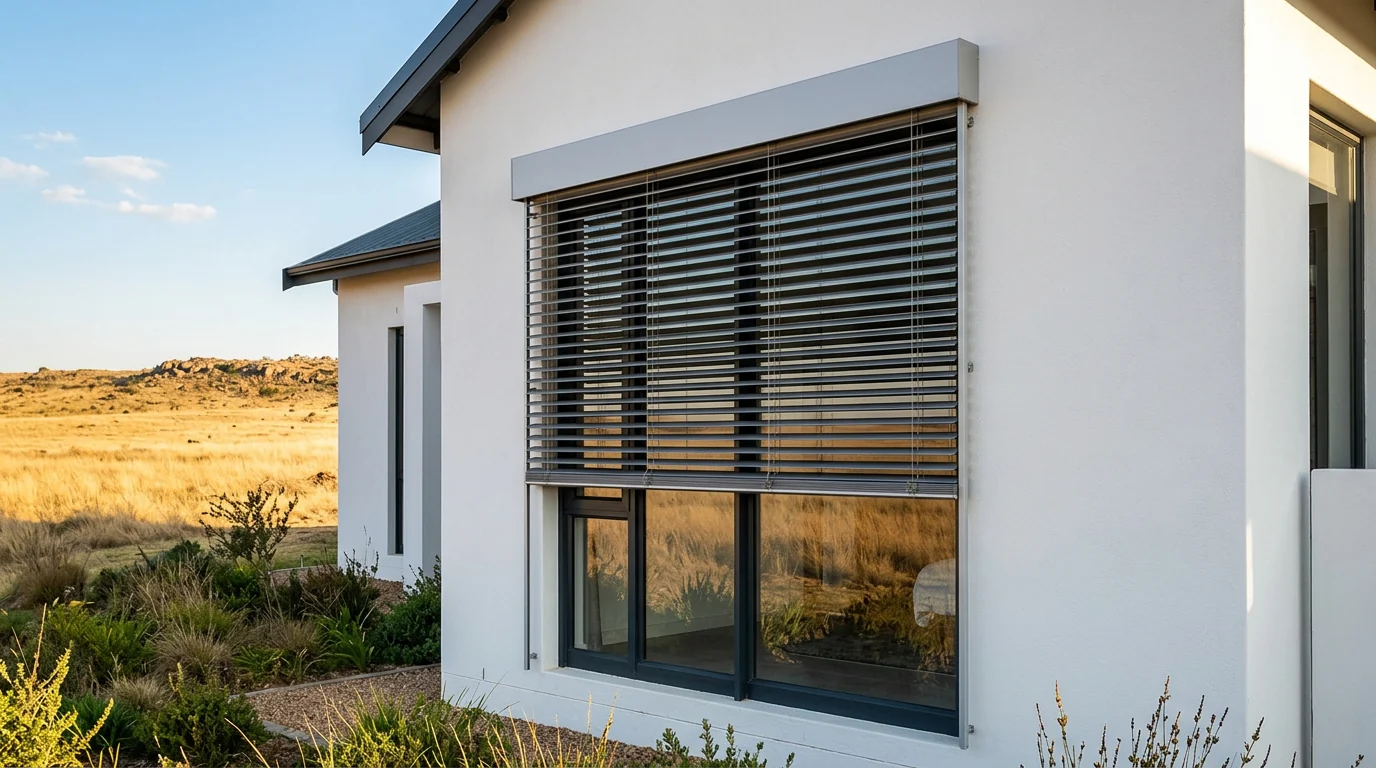
Best on: hard west and north-west glass with nothing shading it
Why here. Both stop the sun outside the glass, which is a different result from stopping it inside. An interior blockout kills glare the moment you drop it, but the pane behind still absorbs heat and radiates it into the evening. External venetians tilt, so a view survives them; roller shutters close right down and roll away into a compact headbox.
The catch. In relative terms these are the dearest answers here. Both want a motor and a wind strategy through the storm season, and both are exterior alterations on an estate where the exterior is governed.
Shading, not security. Our roller shutters are made for sun, heat, glare and privacy control on the outside of the glass. They are not security-rated shutters — that is a different product, which we can quote on request.
Folding-arm awnings & zip screens
Best on: the main patio, the braai side, the pool terrace
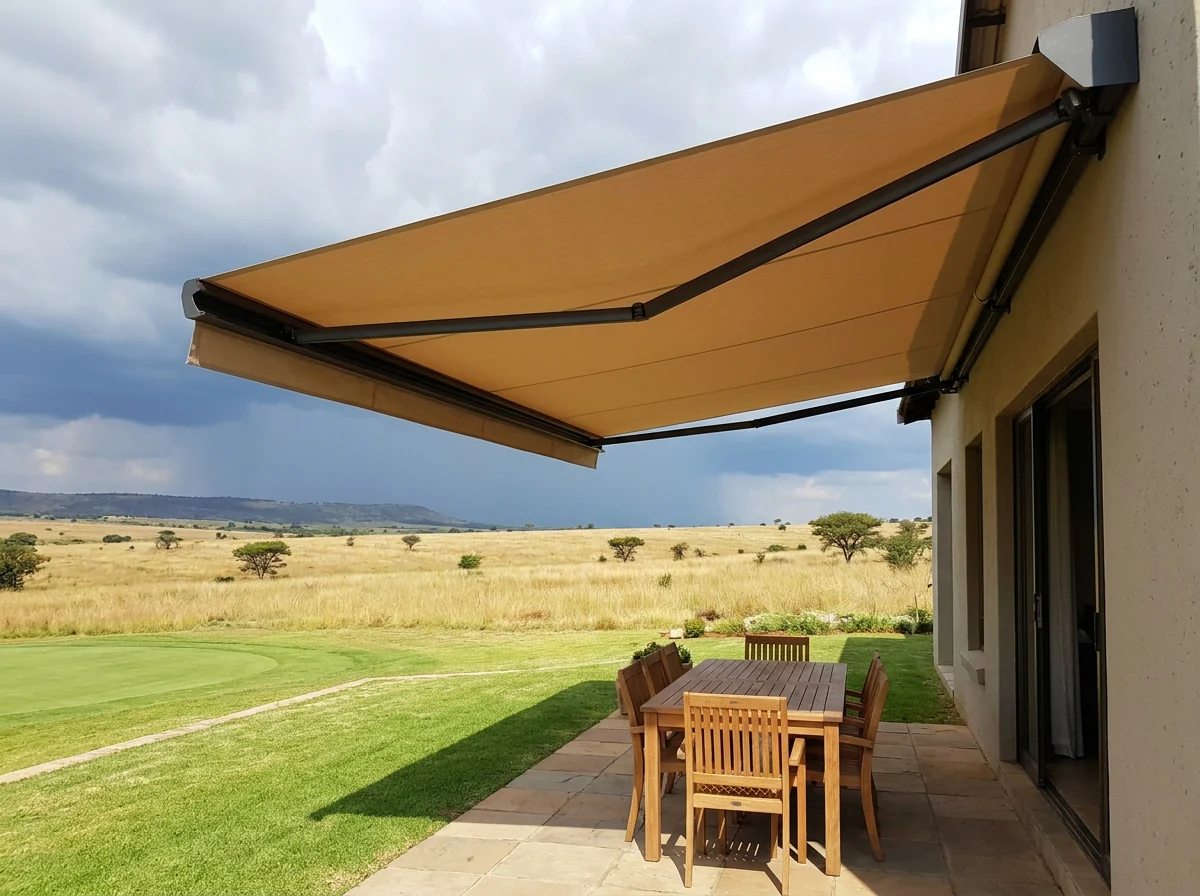
Why here. The guidelines require an unobstructed four-by-six-metre patio off the living areas, with three metres of cover on the main one. A folding-arm awning delivers that on articulated arms with nothing standing on the paving, then folds away in June when you want the winter sun back — which a fixed roof cannot do. A zip screen holds mesh under tension in side channels, keeping its shape in moving air.
The catch. Wind and hail ratings are engineering limits, not marketing copy, and an awning caught open in a November gust does not survive it. We would rather specify a motor and a wind sensor that retracts it while you are out than a manual crank you have to remember.
Motorisation & automation
Best on: double-volume glass, anything above reach, everything outdoors
Why here. A blind nobody can reach is a blind nobody adjusts, and an unadjusted blind is just a permanently dark room. Outdoors it is not a convenience: a wind sensor retracts an awning before the gust arrives, including while you are on the ninth. It also removes cords entirely.
The catch. Motors need power, and finding a cable route that avoids chasing a finished wall is a real question on a completed house. Battery motors trade that for a charging routine.
The bit people forget
Outside the glass is where the estate has an opinion.
Optional
Want this Handbook marked up for your own house?
Tell us which rooms are the problem and we'll send this back with notes against your own elevations — which answers above we'd start with, and which we'd leave alone. No visit, no obligation.
Estate guidelines
What the Architectural Review Committee has already decided for you
Eye of Africa's published Architectural Guidelines (Revision 7, 14 September 2017) are unusually explicit about shading. Section 6.2 recommends deciduous planting, eaves, awnings, canopies, sunscreens and double glazing against excessive direct sunlight. The energy matrix in 6.7 goes further: plans must score at least 27 points for approval, and the scored items include roof overhangs over 600 mm, window hoods, protection to west windows and other external sun controls. Shading is on the scoresheet.
Then, in the section governing what the house may look like, the same document states that "shade nets and canopies are not permitted" and that "external blinds or shading devices are permitted, provided they do not have scallops and consist of fabric of a single approved colour" — those elements being subject to approval.
Those two passages read differently and we will not pretend to resolve them from a website. In practice it is clear enough: the fabric colour on anything visible from the fairway is the committee's call rather than a showroom one, a scalloped valance is out, and the document says openly that the review is subjective.
So we work in the sensible order. Before anything exterior is ordered we hand you a spec sheet and a fabric colour reference to put in front of the committee under the current revision, and we wait. It costs a week and saves a re-manufacture. Outside the estate boundary there is no committee, and far less shelter — which pushes the specification the same way anyway.
Honest limits
Five things this page cannot settle from here
Everything above is reasoning from research. These five are measurements, and they routinely change the recommendation — which is why the measure is free.
The reveal depth, and what the frame is made of
How deep the opening is, and whether the frame takes a fixing, decides inside-mount versus outside-mount — and that decides whether a blockout blind leaves a light line down its edges. Impossible from a photograph.
Where the sun genuinely lands, at the hour it bothers you
Sun-path figures describe the sky, not your house. A neighbour's roofline, a change in level or the way the stand sits on a contour can move the problem by an hour. We'd rather come at four and watch it.
Wind exposure on that specific corner
Two patios on the same street behave differently depending on which way the veld runs at them. That reading sets the awning size, the arm projection, and whether a zip screen is wiser.
Power, and the route to it
Every motorised decision comes back to where a cable can go without chasing a finished wall. On a completed house that usually decides mains versus battery, and it needs eyes on the ceiling void.
The current committee wording, and what the neighbours already carry
Revisions change. Before quoting anything exterior we check the revision in force, the approved colour, and what has already been passed next door — a precedent is the fastest route to approval.
Two ways forward
Have us come and measure — or just get a range first
Both start on the one short form below.
Recommended
The free expert measure & written quote
A consultant comes with fabric and slat samples, walks the elevations at the hour that bothers you, measures every opening properly and leaves a written quote itemised per window. Free, nothing owed at the end.
We take five or six measure appointments a week across Eye of Africa and the Walkerville side, so the diary fills early.
Pop in rough sizes and we'll send a budget range by the next working day. Not sure how to measure? Leave it out — our consultant measures for free either way, and that is where exact per-window pricing comes from.